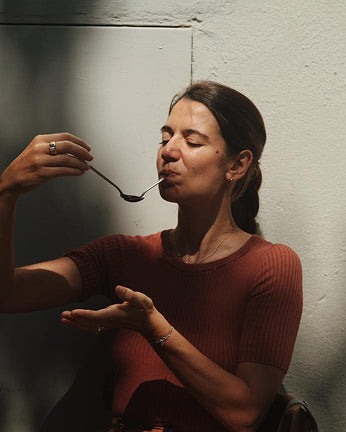
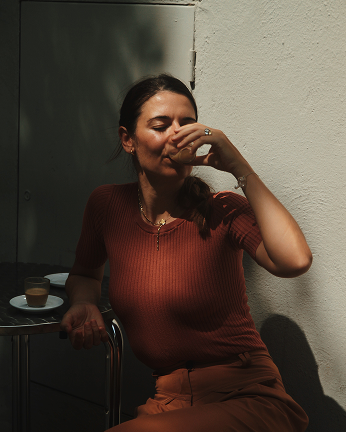
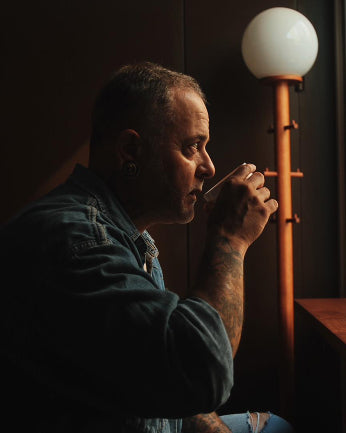
Everyone has their own idea of what makes a good cup of coffee. It’s a personal journey, shaped by the preferences we develop as we grow and change, by our different moods, and by the people we meet along the way.

Behind every cup lie quirks, memories, rituals, and small gestures—things that speak not only to how we like to drink it, but also to who we are and how we understand the world around us. 

(03)
Dear Nomad:

From: Sergi Subject: Another Way

Play Unmute

A little quirk, a way of seeing the world
.

Nomad Coffee
Nomad Coffee
Nomad Coffee
Nomad Coffee
Nomad Coffee
Nomad Coffee
(02)
Dear Nomad:

From: Alba Subject: The Order of Chaos

Play Unmute

Everyone finds their own way to bring
order to their world.

Nomad Coffee
Nomad Coffee
Nomad Coffee
Nomad Coffee
Nomad Coffee
(01)
Dear Nomad:

From: Georgina Subject: Family Heirlooms

Play Unmute
Nomad Coffee
Nomad Coffee

Objects that become memories.

Nomad Coffee
Nomad Coffee
Nomad Coffee

What do you need to
start your own story?

What's your story with coffee?

Maybe it starts with one person, in a coffee shop, or with a mug you bought while traveling. A morning ritual, a tradition passed down, or a routine you think works only for you. Every story has something to tell.

Dear Nomad:

From: Fabi / Subject: A HOME 12,000 KM AWAY FROM HOME.

I’m writing this from my little apartment in the Raval. I have the window open because, even though it’s mid-September, it’s still hot. I live across from a plaza; it’s 7 p.m., and there are kids playing, dogs barking, and friends chatting on the terrace of the bar across the street. If I go downstairs and walk to the right, there’s the neighborhood bakery; and if I keep going 400 meters, I’ll end up right at my favorite coffee shop. Today I went there for my third cup of coffee of the day. I didn’t really need that third cup of coffee. But I did need to greet someone with the warmth that comes from a routine.

I had my first cup of coffee when I was 29. I think that’s one of my weirdest fun facts—of the ones I can admit to—considering I’ve been working with coffee for much longer than that. In my childhood home, we drank mate, not coffee. So, even though I’m a very melancholic person, there’s no nostalgia here at all. That devotion I feel for my little cup of coffee takes me nowhere else but Barcelona. That memory is tied to this city.

Almost all of the 12 years I’ve spent here have been intertwined with coffee. Far from my comfort zone, my friends, and my family, I had to become a different version of myself. I had to create new routines and a new comfort zone with new friends. This is where I began to find that hope in coffee shops—in meeting up for a cortado after lunch, in trying the filter coffee a random colleague brought back from Denmark—the hope that, even though I’m 12,000 kilometers away from my first favorite place in the world, I can build other favorite places, other rituals, and keep them alive.

Apparently it’s going to rain tomorrow and the temperature will drop. I’ll head out to grab a slice of Forner’s coca for breakfast with a cup of batch, watching the empty plaza in the morning and the girl at the bar across the street also sipping her first coffee with a cigarette before setting up the outdoor seating area.

Play Unmute
Dear Nomad:

From: Roberto / Subject: Four Giny

A few years ago, I had an old manual coffee grinder: as you turned the handle, you had to earn your daily cup of coffee, but it was worth it. Later, since my job was taking up an increasingly large portion of my time, I had to give up that magic and switch to an electric one. But coffee makers—those are off-limits: I have four, and they’re all strictly necessary.

A Venezuelan friend who was clearing out her house in Tenerife gave me the French press as a gift. It fits perfectly into my morning routine: a little over a minute, neither too strong nor too weak—it’s my favorite coffee. It makes no more than two cups, and that’s perfect: the first on the terrace, the second right when I get to work.

For days on call, there’s the filter coffee maker, which is programmable. Although I’m not entirely convinced by the result, waking up to that heavenly aroma that already fills the house makes me feel privileged, and it makes enough that I can fill a large thermos. A twenty-four-hour workday is already unbearable enough on its own, and things get even worse if you have to resort to those horrible capsules or—argh!—instant coffee.

The moka pot, on the other hand, is for the afternoon. When I put it on the stove, I think of my grandmother, sitting there waiting to see the first drop fall before turning off the flame at the first “glo-glo.” “The consistency is different; you have to stir it,” she’d say as she swirled a small spoon inside the pot, before pouring the coffee into the green glass cups from our beach house. She’d serve store-bought, bitter coffee and add white sugar. Every now and then I do the same, to honor her memory.

I gave the Pavoni to my father, and it pained me to see that the two of them didn’t click. But it takes time for the machine to warm up, and my old man always has great patience—except when he wants to have a cup of coffee. So I took it back, and I break it out when I have guests over for afternoon tea: that chrome lever you have to push down impresses everyone, and the espresso that comes out of it is perfect for making an affogato.

Four mugs, four drinks, four unforgettable moments. As I’m writing this, I’ve gotten the urge to look for the fifth one…

Dear Nomad:

From: Ryan / Subject: Impromptu coffee in Madrid

I remember that café almost as clearly as I remember Madrid.

It was already mid-morning, hot enough that we’d started looking for the shady side of every street. We’d been walking aimlessly for a while, in that in-between moment between breakfast and whatever came next, when we found a small café tucked away from the busiest streets. Inside, it was cool and calm, with the soft clinking of cups and the low murmur of conversation.

I ordered an espresso. The barista told me they used beans from NOMAD, a Barcelona-based Roaster I’d heard of but had never tried. It struck me as a bit odd to find coffee from Barcelona in Madrid, but at the time I didn’t think much of it.

The coffee arrived in a small ceramic cup, with a glass of water beside it. I remember that the first sip was unexpectedly bright: fruity and almost sweet, without the intense bitterness I usually associated with espresso. After that, I relaxed. Instead of drinking it quickly and heading back out, I stayed there, turning the cup in my hands and taking small sips while watching people pass by the window.

There was nothing particularly significant about that morning. We didn’t visit any famous monuments or have any great revelations. After the coffee, we paid, stepped back out into the Madrid sunshine, and kept walking.

But, somehow, that’s precisely why I remember it.

Years later, every time I see a bag of beans from NOMAD, I think of that little café: the cool room, the intense light from outside, my legs tired from all the walking, and that feeling of not having to be anywhere in particular. For a few minutes, Madrid was reduced to something very simple: a small cup of coffee, a chair by the window, and time passing unusually slowly.

Dear Nomad:

From: Seva / Subject: Where Water Boils at 86 Degrees

In the mountains, almost everything is simplified. You sleep fully clothed, shower every three days, and eat whatever’s available. Comfort fits inside your sleeping bag, and it’s a fair trade: you sacrifice comfort for what you came here for—the great mountains. But there are things that aren’t simplified, because they no longer have anything to do with comfort. They’re who you are.

On the Manaslu trek in the Himalayas, I made myself a cup of coffee every morning. Not out of stubbornness (well, maybe a little), but because otherwise my morning just wouldn’t get going. Preparing it turned out to be more complicated than the trek itself: filtering the water and remineralizing it, preheating everything I could, and tweaking the recipe every day because yesterday’s version no longer worked at the new altitude. Finding a lighter dripper that wouldn’t steal heat from the water, keeping the paper filters and coffee tightly sealed. Packing it all into my own coffee kit, which I insisted didn’t weigh that much. In places as beautiful as Samagaon (3,560 m) or Samdo (3,860 m), water boils at less than 90 degrees, and believe me: that’s not the hardest part.

Why go to all that trouble when there are drip coffee packets and instant coffee? Some villages even have espresso machines!

Because, for me, making coffee isn’t just a ritual. It’s twenty minutes alone with myself—and yet, completely in the here and now. You watch the water, how the coffee swells, the stream, the timer, and the scale; and at the same time, you see the valley, the sun touching the peaks, you hear the camp waking up, you feel the cold in your hands. The small and the immense fit in my mind at the same time, effortlessly. I know of no other way so reliable to immerse myself fully in what’s happening and get myself ready for the day.

Down below, making coffee is a pleasure. Up here, it turns out to be a necessity. When everything else is taken away from you (even if just for a couple of weeks), the ritual is the only thing that remains intact from who you were before.

The mountains leave their mark on you. I don’t see mine in the photos, but rather in the mornings, when, out of habit, I heat the dripper a little too long and, for a second, I hear the camp wake up.

Dear Nomad:

From: Luis / Subject: I don't need an excuse to have a cup of coffee

At home, coffee has always been a special moment. The sound of the coffee maker in the morning, the aroma that filled the kitchen, and that first cup my parents would drink—it seemed to signal that the day could finally begin. For years, I saw it as a simple habit, until I realized that, in reality, it was a little way to pause.

Now I have my own ritual. The first cup of the day isn’t rushed. While the rest of the house starts to wake up, I sit for a few minutes, coffee in hand, and enjoy that brief moment of silence before the noise begins—breakfast, my daughters, getting ready for school or work, and everything else.

Over time, I’ve discovered that what I like most about coffee isn’t just the coffee itself. It’s everything that surrounds it: the cup you’ve chosen, the aroma before the first sip, the time of day, and, above all, the feeling that for a few minutes, you don’t have to do anything else.

Maybe that’s why I’m paying more and more attention to what I drink. Because a good cup might last five minutes, but it can turn those five minutes into one of the best moments of the day.

And I guess that’s my story: I don’t need a big excuse to drink coffee. I just need it to be my coffee time.

Dear Nomad:

From: Txema Rueda / Subject: When Coffee Became an Obsession

When I arrived in Vancouver in 2015, I started working at Tartine Bread and Pies. Everyone seemed to be there for the pies and desserts. I looked at them, too, but while everyone else was talking about pastries, I found myself paying more and more attention to what was happening behind the counter as I worked as a barista. I became obsessed with the coffees I served and prepared and began to learn about each customer’s quirks. Why did everyone order their coffee differently? Wasn’t it enough for them to just have a cup of coffee and be done with it?

The coffee was supplied by Revolver Coffee, and I became obsessed with figuring out which one was the best and why. At first, I thought it was all about achieving the perfect extraction: weight, grinder or machine calibration, ratios, etc. Later, I began to understand the cultivation processes and methods, altitudes, drying, and so on. Until finally, thanks in part to Scott Rao, I became obsessed with roasting, roast curves, and those elusive “cracks.”

I especially remember a Colombia Pink Bourbon from the Restrepo family. I don’t know if that was the first time I truly understood what coffee could be, but I do know that after tasting it, I started to perceive cups of coffee differently. It was no longer just coffee: there was origin, variety, processing, roasting, the hands of the people involved, and the places behind it all.

I think that’s where my problem began.

I wanted to understand it all. I started going a little crazy, obsessed with the physics of coffee, and my friends went from being interested in my stories while I made them coffee at home to getting a bit fed up with having to attend physics classes on a Sunday afternoon.

When I returned to Spain, I bought a Rocket Appartamento and a Niche. Then came the pour-over methods—the V60, the Origami, cold brew… and just when I thought I’d learned enough about extraction, a new question arose: what if the coffee I was looking for didn’t exist?

That’s when I started roasting.

I took a course with Scott Rao, bought a 1-kg Aillio Bullet, and began roasting my own coffee. At first, just for myself. Way too much caffeine. Then, for friends. And, almost without realizing it, during my paternity leave for my second child, I ended up starting Norte Coffee Roasters.

Years have passed, and although my obsessive-compulsive tendencies have eased, I still have a few quirks. In the mornings, a flat white. After lunch, an espresso. On weekends, V60 or Origami. In the summer, cold brew with ice and a slice of orange.

And I still brew every espresso as if that cup were the first one.

Maybe because, in a way, it still is.

Dear Nomad:

From: Minlu Yan / Subject: A New Bag, a New Ritual

A New Bag, a New Ritual

Every new bag of coffee starts the same way for me.

I open it, smell the beans, check the roast date, and then start adjusting my Philos grinder. The first espresso from my Linea Micra rarely comes out perfect, but that’s exactly what I like: experimenting, changing the grind, and gradually finding the cup I’m looking for.

I often bring back beans from different roasters when I travel, so each bag feels a little different. Some remind me of a city or a café; others simply become part of my mornings for a few weeks.

Then, one day, the bag runs out.

I clean the grinder, open another bag, and the ritual begins all over again.

Dear Nomad:

From: Marcos Alexandre / Subject: I smell it before I drink it

Before taking my first sip, I always bring the cup close to my face and breathe in. Just for a few seconds.

I don’t do it for any particular reason. It’s that moment when the day hasn’t quite started yet, but it’s almost here.

Then I take a sip, and it doesn’t matter anymore whether it tastes good or just okay. The best part is already over.

Dear Nomad:

From: Alessandro / Subject: Coffee doesn't start until everything is in place

I have a little quirk when it comes to coffee: I don’t like to drink it in a hurry or just any old way. I need my moment, my cup, to sit somewhere I like, and to sip it slowly. It’s not so much the coffee itself, but the whole ritual surrounding it.

When I travel, one of the first things I do is look for a coffee shop where I feel like staying for a while. I like to watch people, look out the window, and feel like, for a little while, I’m part of that place.

I guess it’s my way of creating a little routine wherever I am. If I miss that moment, I feel like the day has started differently.

Dear Nomad:

From: Julio César / Subject: The Little Streets of Buenos Aires

I started drinking coffee at the same time I was beginning to live my adult life away from home. Going to a film series, seeing a contemporary art exhibition, visiting a friend who was taking a workshop**... These were all** excuses to go have a coffee before or after, in downtown Buenos Aires.

The “notable cafés” are a symbol of the city, and I began frequenting several of them: at the London City**—where Cortázar was a regular—** I discovered “Viennese coffee” (which doesn’t exist in Spain); at La Biela, where Borges and Bioy Casares used to go, I’d stop by before my museum tour in Recoleta; at Margot in Boedo, I imagined myself as a tango dancer from the ’40s.

Now settled in Madrid, I discovered the “specialty coffee shop,” and since then I’ve found it hard to drink “the other kind,” but the ritual remains: stopping by Dot before Matadero; a book or magazine by the window at Toma; a breakfast of yogurt and granola at Bartolo**,** here**,** in my new home, Alcalá de Henares. In good company.

Dear Nomad:

From: Pablo / Subject: The Man in the Dining Room

I have a vivid memory of the man who used to sit at the dining room table. Sometimes he’d trick me into making his cup of coffee… I’d always go ask him, “How’d it turn out?” He’d always reply, “The best I’ve ever had.”

What was the secret behind it? The love of a 10-year-old son.

Dear Nomad:

From: Theodoris Meko / Subject: College Years: Trying to Save Money

When I was a college student, a friend introduced me to the moka pot in 2018. I bought one right away because I was trying to save money on coffee.

At first, I experimented with supermarket coffee, until I discovered a shop near my house that sold nuts and surprisingly good coffee. That was probably the start of my rabbit hole.

Some time later, when I was already working, someone made me a cup of coffee using a hand-pumped espresso machine: the Wacaco Picopresso. I was fascinated by the idea that you could make something so close to espresso with such a compact machine, so, unsurprisingly, I bought one for myself.

Later, I discovered a specialty coffee shop in Greece and started ordering ground coffee from them. At one point, they got the grind size wrong and sent me coffee that was ground too fine. 😭

That’s when I thought: okay, enough is enough—I’m going to set up a proper setup. I ordered a good manual grinder and a coffee scale, and the rest is history.

Fast forward to today, and somehow I’ve ended up with a Gaggia Classic Evo Pro E24, a Eureka Mignon Zero, and a ton of coffee accessories that I certainly didn’t need… haha.

Dear Nomad:

From: Alba / Subject: From the library to the coffee farm

I started drinking coffee when I began studying for a civil service exam. Coffee had never really caught my attention; it was just that bitter stuff my mom used to make—first with a drip coffee maker and later with an espresso machine. Supermarket coffee was the only kind I knew until I gradually discovered specialty coffee.

I gradually realized that coffee didn’t have to taste burnt and that it could have different notes, flavors, and colors. Little by little, coffee went from being a necessity to a daily ritual—a moment of pause and reflection.

My interest in coffee continued to grow, and I think it reached its most memorable moment when I traveled to Colombia and was able to visit various coffee farms. It was an experience I’ll never forget.

From us

If you've shared your story with us, check your email. 

You'll have a surprise coming soon.